

Introduction
School readiness is not just about having good policies. It is about whether those policies, systems, and practices actually work consistently across the school.
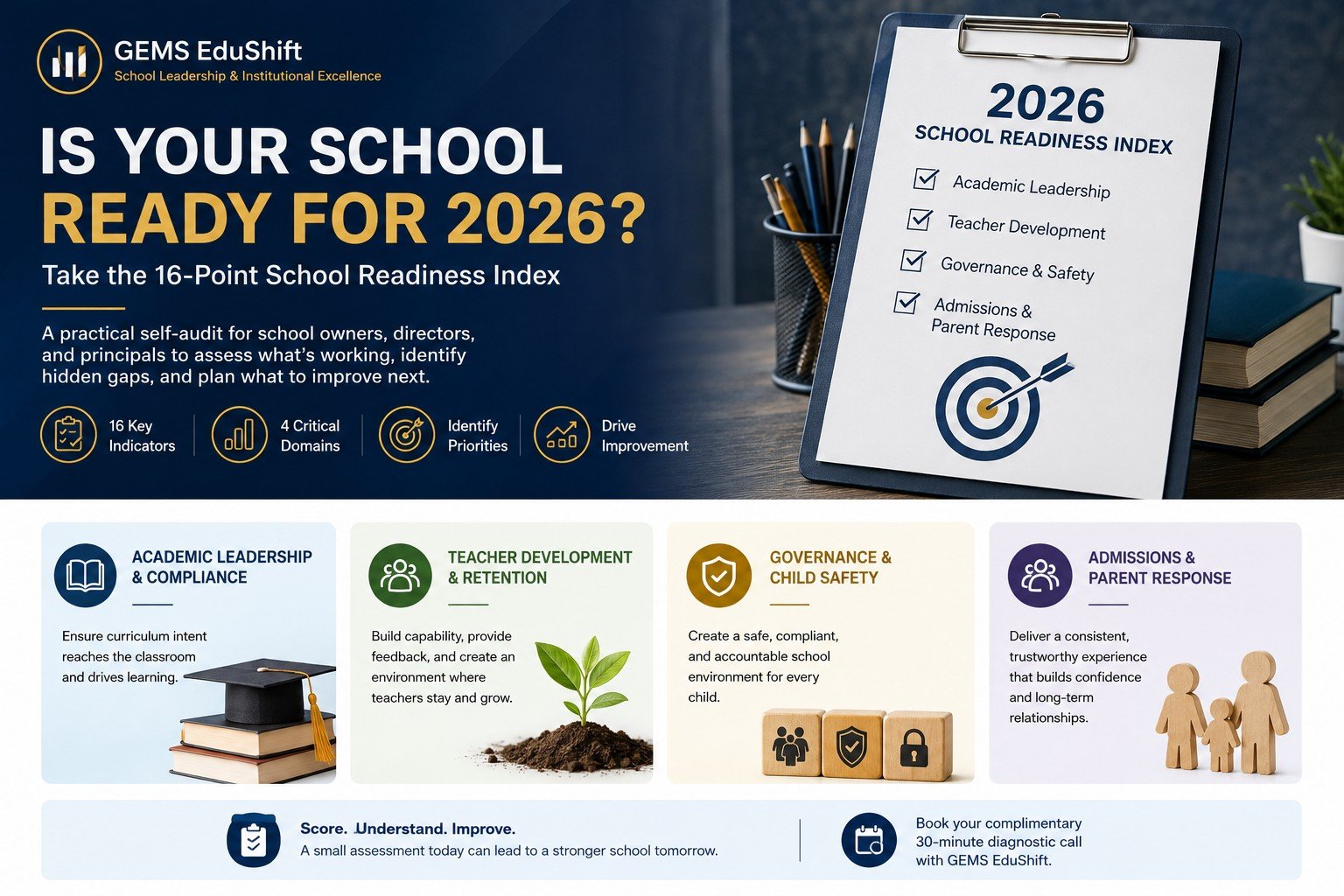
The 2026 School Readiness Index by GEMS EduShift is a practical 16-point self-audit designed for school owners, directors, and principals to assess where their school stands—and identify where improvement should begin.
The assessment covers four critical areas:
- Academic Leadership & Compliance
- Teacher Development & Retention
- Governance & Child Safety
- Admissions & Parent Response
Each statement is scored from 0 to 2, giving a total score out of 32.

How It Works
For each statement, select:
0 — Not in place
1 — Partial or inconsistent
2 — Consistently in place
Once you complete all 16 questions, your score will indicate your school’s current readiness level.
Interactive School Readiness Assessment
Is Your School Ready for 2026?
A practical 16-point self-audit for school owners, directors and principals. Assess what is working, identify hidden gaps, and discover where improvement should begin.
2026 School Readiness Index
Rate each statement 0 (not in place), 1 (partial or inconsistent), or 2 (consistently in place). Your total score is out of 32.
Ready to close the gaps?
GEMS EduShift offers a complimentary 30-minute diagnostic call to walk through your results and flag the two or three changes that will move the needle fastest.
Visit GEMS EduShiftUnderstanding Your Score
0–15 — Critical Need
Structural gaps are likely already visible to parents and staff.
16–25 — Moderate Risk
The foundation is in place, but inconsistency may be affecting enrolment and retention.
26–32 — Strong Footing
Your systems are largely working. The opportunity is now to fine-tune rather than rebuild.
What Should You Do Next?
Your score is only the starting point.
The Index recommends three simple steps:
1. Score honestly
Ideally, have a senior colleague complete the assessment independently as well.
2. Identify your three lowest-scoring areas
These become your immediate priorities—not a reason to tackle everything at once.
3. Get an outside perspective
A fresh assessment can help identify which changes are likely to create the greatest impact.
Ready to Close the Gaps?
GEMS EduShift offers a complimentary 30-minute diagnostic call to walk through your results and identify the two or three changes that could move the needle fastest.
GEMS EduShift — School Leadership & Institutional Excellence