


By Gopal Dutta
School Leader | Coach | Educational Consultant
“Our teachers are hardworking. So why aren’t we seeing better results?”
This is one of the most common questions school leaders ask me.
The interesting thing is that they rarely begin by talking about students.
Instead, they talk about committed teachers, long working hours, increasing competition, demanding parents, and the constant pressure to improve results.
After spending more than two decades working with schools, I have realised something that surprises many leaders:
Most schools don’t struggle because people lack commitment. They struggle because good people are working without a shared system for improvement.
There is an important difference.
Dedication alone can keep a school running.
But only systems can help it grow.
The Hidden Ceiling Every School Reaches
Imagine a school that has been operating successfully for ten years.
Teachers know their subjects.
The principal is experienced.
Students perform reasonably well.
Parents are generally satisfied.
Everything seems fine.
Then something begins to change.
A neighbouring school introduces modern teaching approaches.
Parents start asking about technology integration.
Student expectations evolve.
New teachers join with different experiences.
Old routines no longer produce the same results.
Suddenly, the school finds itself working harder but not necessarily moving forward.
This is the moment when many institutions reach what I call the invisible ceiling.
It isn’t created by lack of effort.
It is created by the absence of continuous professional growth.
School Improvement Is Like Building a House
One way I explain this to school leaders is through a simple illustration.
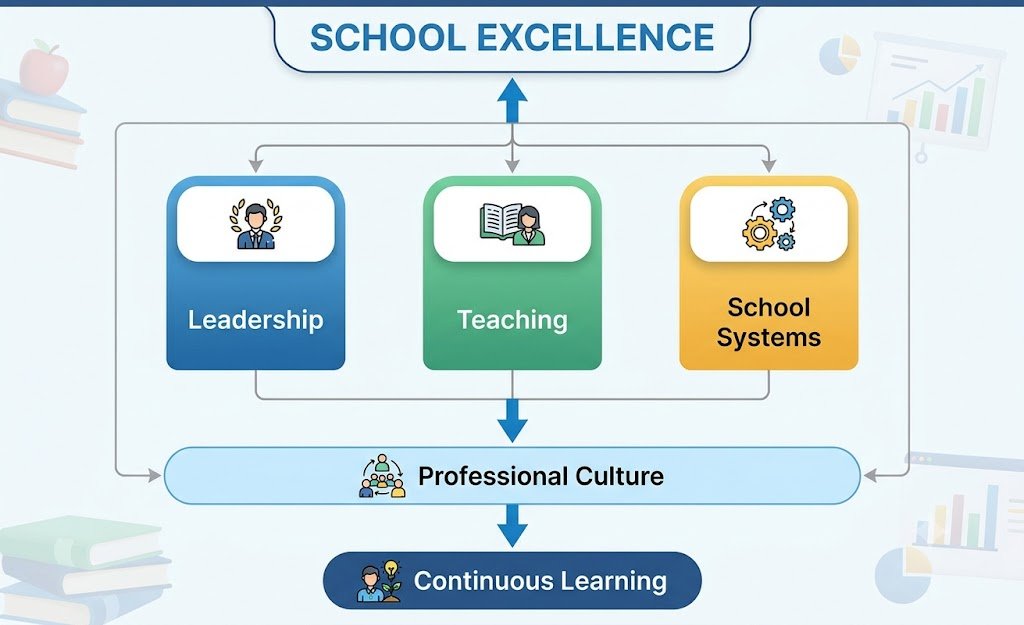
Many schools try to strengthen only one pillar.
Some focus only on teacher training.
Others focus only on administration.
Some invest only in technology.
But excellence is never built on a single pillar.
It grows when leadership, teaching, systems, and culture develop together.
Why One Workshop Rarely Changes a School
I have attended and delivered many professional development programmes over the years.
Most participants leave inspired.
Everyone promises to try something new on Monday morning.
A few weeks later, daily routines return.
Not because teachers don’t care.
Because changing professional habits is difficult without support.
Learning something new is only the first step.
Applying it consistently is where transformation begins.
That’s why sustainable improvement requires:
- Clear leadership
- Practical implementation
- Coaching
- Reflection
- Feedback
- Follow-up
Professional learning should not end when participants receive a certificate.
It should begin there.
A Lesson From High-Performing Schools
One characteristic appears again and again when visiting improving schools.
Their leaders ask different questions.
Instead of asking:
“Who made the mistake?”
they ask:
“What can we improve together?”
Instead of asking:
“Who should attend the training?”
they ask:
“How do we ensure everyone applies what they learn?”
The difference may sound small.
In reality, it changes everything.
Because school improvement is not an event.
It is a culture.
The School Transformation Cycle
One model I often share with school leaders looks like this.
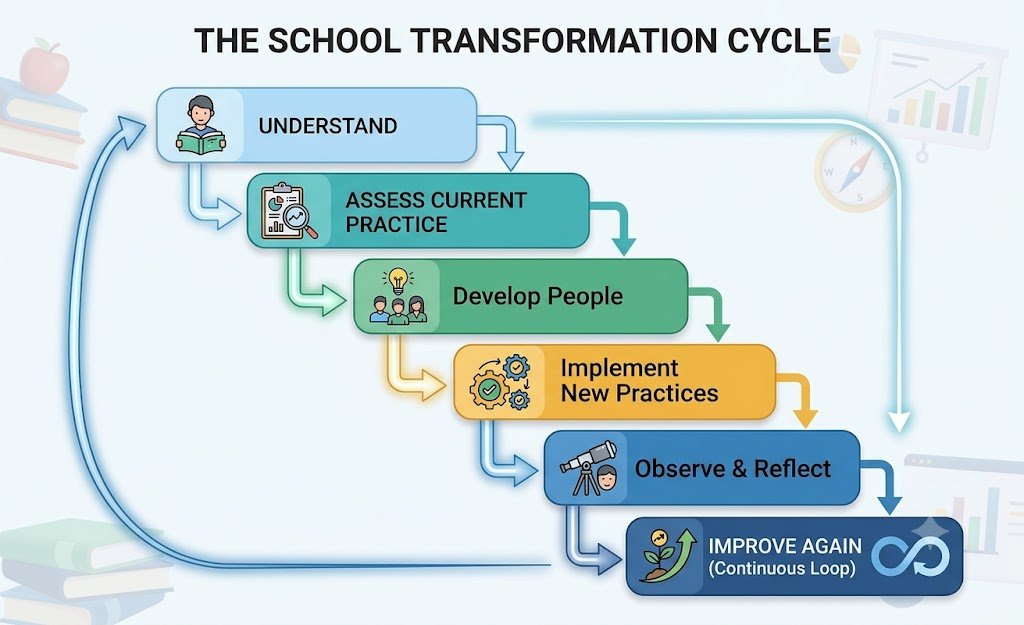
Notice something important.
There is no finish line.
Great schools don’t “complete” improvement.
They continue improving.
Where Should School Leaders Begin?
Whenever a principal asks me,
“What should we improve first?”
my answer is almost always the same.
Don’t begin with buildings.
Don’t begin with technology.
Don’t begin with expensive infrastructure.
Begin with people.
Strong schools are built by:
- leaders who continue learning,
- teachers who continue growing,
- systems that support good practice,
- and a culture where improvement becomes everyone’s responsibility.
Buildings create impressions.
People create impact.
A Question Worth Reflecting On
If your school looked exactly the same three years from now as it does today—
would you be satisfied?
If the answer is no, then the journey of improvement has already begun.
Not because your school is failing.
But because every great school understands that excellence is never a destination.
It is a habit.
About GEMS EduShift
At GEMS EduShift, we believe meaningful school improvement happens when leadership, teaching, academic quality, and institutional systems grow together. Our programmes are designed to help schools move beyond one-time workshops toward sustainable professional growth through coaching, practical implementation, and long-term partnership, reflecting the philosophy outlined in our prospectus.